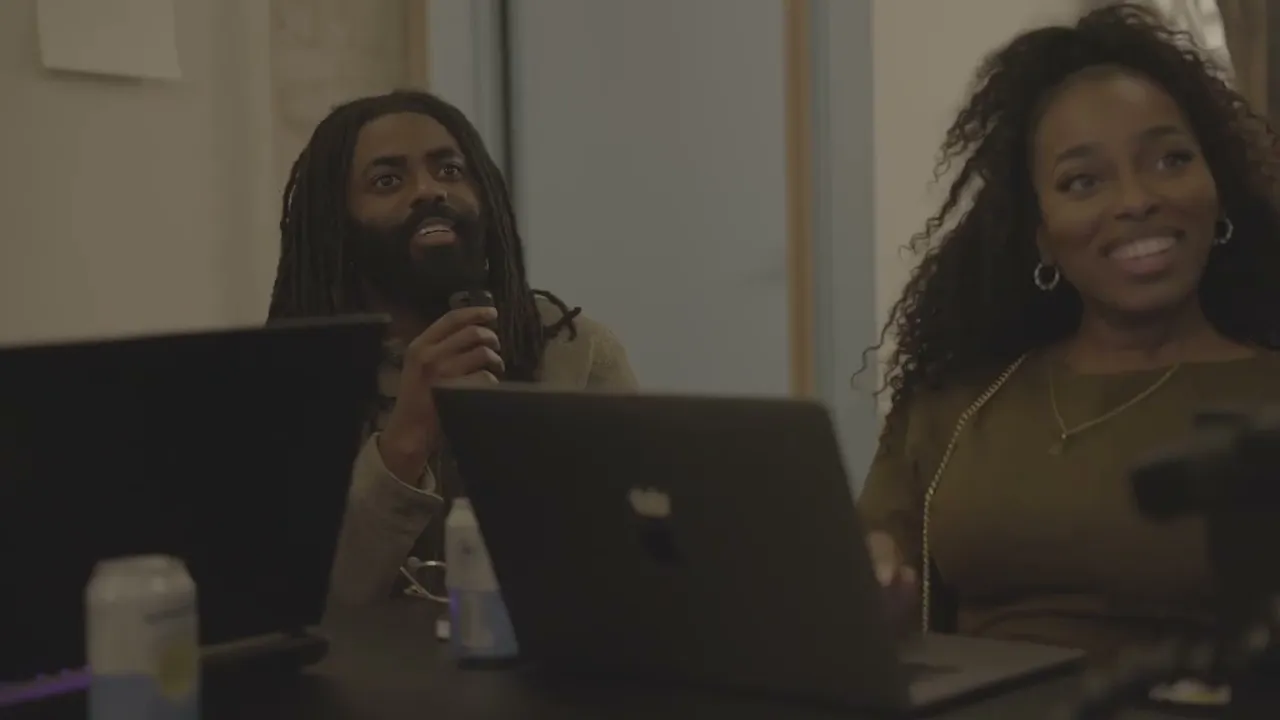
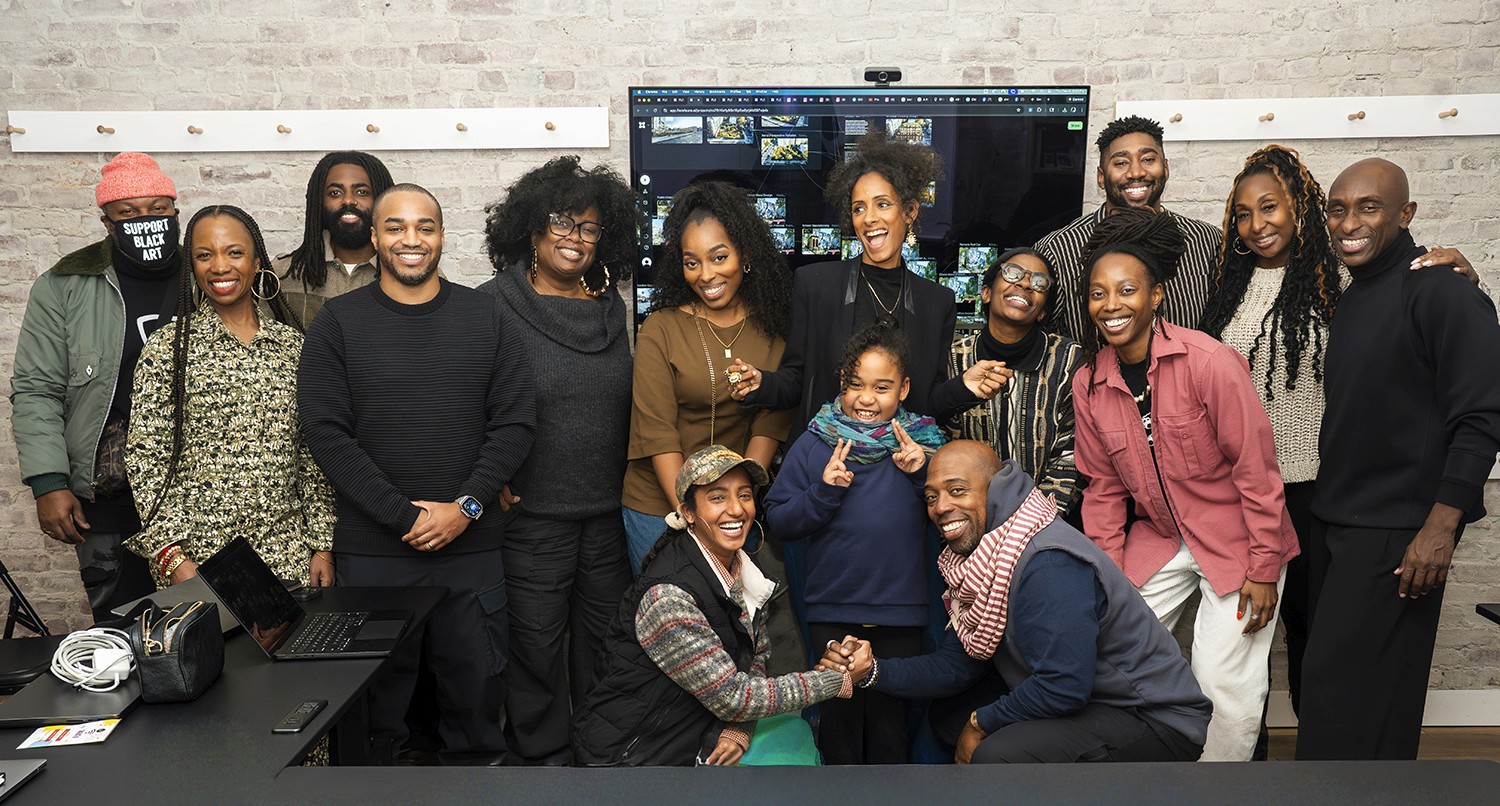
In December 2025, Prompt & Purpose partnered with The Laundromat Project to host a community-centered AI hackathon in Bed-Stuy, Brooklyn.
But this wasn’t a traditional hackathon.
There were no startup pitches, no coding competitions, and no pressure to “build the next big thing.” Instead, artists, technologists, organizers, and residents gathered in a room to ask a different question:
What happens when communities are given the tools to visualize the futures they want to live in?
For one evening, Bed-Stuy residents worked alongside AI-literate artists to transform lived experiences, memories, frustrations, and hopes into visual futures using tools like Sora and FLORA. Together, they explored how AI could be used not as a replacement for creativity or culture, but as a tool for storytelling, preservation, advocacy, and imagination.
Why The Laundromat Project?
The Laundromat Project has long been a cultural anchor in Bed-Stuy, advancing artists and neighbors as change agents within their own communities. Their work is rooted in supporting cultural leadership, preserving local stories, and creating opportunities for residents to shape the future of their neighborhoods.
Prompt & Purpose partnered with LP because the questions surrounding AI are not abstract. They are already impacting communities through access, education gaps, representation, labor shifts, and cultural visibility.
Rather than approaching AI from a place of fear or inevitability, this collaboration asked:
How can communities use these tools on their own terms?
The goal was not simply to teach technology. The goal was to create a space where residents could imagine, discuss, and visualize the futures they want to see reflected in Bed-Stuy.
Reimagining the Hackathon
Traditionally, hackathons are spaces where developers gather to rapidly prototype technical products.
Prompt & Purpose reimagined that format through a cultural lens.
Instead of building apps, participants built visual stories.
Instead of pitching venture-backed products, residents explored questions around neighborhood identity, cultural preservation, visibility, and collective futures.
Five artists and creative technologists guided residents through the use of AI image and video generation tools, helping them translate ideas into tangible visual outputs.
Participants did not need prior technical experience.
The framework was designed around collaboration:
Community members brought lived experience and vision
Artists translated those ideas visually
AI tools accelerated visualization and experimentation
Learning happened through co-creation rather than instruction alone
Throughout the evening, participants explored three creative frameworks:
1. Empty Lot Transformations
Residents reimagined vacant or underutilized spaces in Bed-Stuy as community gardens, libraries, performance spaces, marketplaces, and cultural hubs.
2. Small Business Visibility
Participants explored how local businesses could use AI-generated visuals and mock campaigns to create marketing materials without needing large budgets or agencies.
3. Speculative Futures
Residents visualized the future version of Bed-Stuy they hoped to see, from greener streets and stronger community ties to spaces designed for safety, joy, and cultural continuity.
While all three frameworks resonated, the empty lot transformations became the emotional center of the evening.
The Empty Lot as a Question
Across New York City, vacant lots often become symbols of stalled progress, speculation, or decisions made far from the communities most impacted by them.
The futures of many empty lots are decided in rooms where communities feel unheard.
For many participants, these spaces represented more than real estate. They represented memory, possibility, frustration, and loss.
Using AI tools, residents transformed Google Maps screenshots and street photographs into speculative visual proposals for what those lots could become.
Some imagined intergenerational gardens. Others imagined libraries, performance spaces, or playgrounds. Some simply imagined cleaner, greener blocks where people felt safe gathering again.
One participant, Will Adams, described wanting to create a community-centered library and performance space inspired by Black cultural gathering spaces.
“Being able to use it with trusted voices was really big for me. I wanted to make a community space, a library and a performance area, and seeing it come to life made it real.”
The ability to quickly visualize these ideas changed the dynamic of the conversation.
Residents were no longer speaking only in hypotheticals. They were pointing to visible futures.
AI as a Tool for Cultural Agency
One of the strongest themes throughout the hackathon was the shift in how participants viewed AI.
Many arrived skeptical. Some were openly resistant.
But through collaboration with artists who approached the tools critically and intentionally, participants began seeing AI less as a threat and more as a medium.
Artist Joy Fennell reflected on her own journey:
“Once I saw how AI could help us write our own stories, I wanted to make sure our people were in the room using it.”
Artist and photographer Delphine Diallo emphasized that technology alone was never the point.
“What kind of story do you want to share that you would never see in Netflix and Marvel?”
For participant Reg Wends, the experience fundamentally shifted his perspective on AI.
“There’s all this stuff sitting in my head that I now know there’s a place to send it — and it can send it back to me.”
The evening became less about mastering software and more about reclaiming authorship.
Residents were not simply consuming technology. They were shaping narratives with it.
What We Learned
The Prompt & Purpose x Laundromat Project Hackathon demonstrated that AI literacy can look different from traditional education models.
The most impactful moments did not happen through lectures or tutorials. They happened through conversation, collaboration, and shared imagination.
Several key insights emerged:
Community-first framing matters
Participants responded most strongly when the technology was grounded in local realities and cultural relevance.
Artists play a critical role as translators
The artists were not simply teaching software. They were helping residents turn abstract feelings into visible forms.
Visualization creates agency
Many participants spoke about how seeing an idea visualized made it feel more tangible and actionable.
AI literacy must include criticality and intention
Participants valued discussions around ethics, ownership, labor, and cultural responsibility as much as the tools themselves.
Building the Future of Prompt & Purpose
This hackathon was designed as a pilot.
Prompt & Purpose is building a replicable framework for community-centered AI education and cultural storytelling that can scale across neighborhoods, institutions, and cities.
The goal is not simply to increase access to technology.
The goal is to create spaces where communities can:
Shape narratives about their neighborhoods
Visualize futures before they exist
Learn creative tools through collaboration
Build cultural agency through storytelling
Explore emerging technology critically and intentionally
The Laundromat Project partnership demonstrated what becomes possible when cultural institutions create room for experimentation rooted in care.
When intention becomes infrastructure, communities can shape what comes next.
This is Prompt & Purpose.
Credits
A Prompt & Purpose Hackathon in partnership with The Laundromat Project.
With support from OpenAI and FLORA.
Featuring artists:
Joy Fennell
Delphine Diallo
Deia Cione
Leighton McDonald
Alexia Adana